
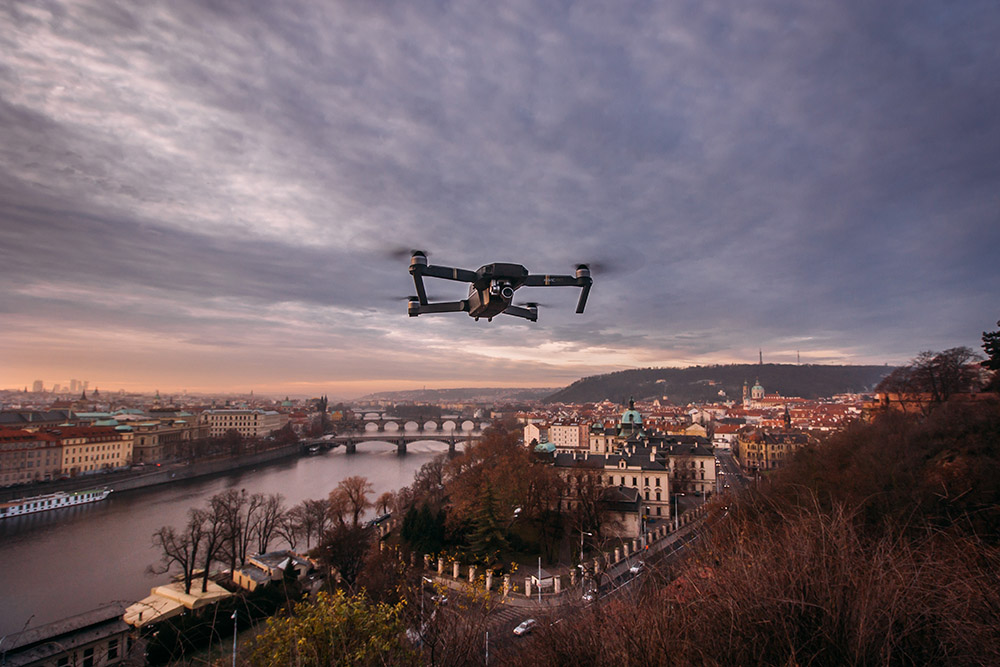
A rising number of construction firms in the UK and Ireland have started using drones on their sites, new research has found.
The survey by ProDroneWorx revealed that 52 per cent of such companies are now making use of this technology, compared to just 33 per cent a year ago.
There were three main reasons for using drones cited by respondents to the survey. At the top of the list with 56 per cent was the improvement of data quality. In second place with 54 per cent was time saving, and in third place was risk reduction, which was cited by 42 per cent of firms.
However, the survey also found that most construction firms don’t use the drones themselves, but bring in external companies to access the technology, most likely due to the level of expertise and training required to use them commercially.
Managing director at ProDroneWorx Ian Tansey said that utilising drone technology could be a way for construction firms to gain an advantage in “an increasingly competitive landscape”.
“The use of digital/reality capture data gives construction firms a decided advantage over the competition by improving the quality of its data, lowering costs, increasing productivity and mitigating risk,” he stated.
The research also highlighted the fact that very few firms are using drone technology to deliver value-add services such as aerial LiDAR, 3D modelling, 3D point clouds and thermal imaging, among other options.
Fewer than 30 per cent of those questioned were using it for these kinds of purposes, although 74 per cent said they were using drones for videos and photography.
The government in the UK is keen for more firms in construction and other industries, such as energy generation, to embrace robotics to help improve safety and increase efficiency.
Earlier this month, it announced it was investing £26.6 million in a number of projects that are exploring how to use robotics in industry settings, such as robots that can detect and repair cracks in underground service pipes and robots that can carry out inspection and maintenance work in hazardous environments, such as offshore wind farms and nuclear power plants.
An article for FE News recently highlighted drones as one of several pieces of technology that are set to change workplaces in a range of industries.
In particular, the news provider pointed to how handy it is to use drones for safety checks, which deliver a number of benefits. It not only saves employees being put in harm’s way to carry out the assessment in the first place, but allows a business to decide on the most efficient and safest way to carry out any work before sending people in to fix any issues.
Other pieces of technology that are set to change the way we work include autonomous vehicles, check-in technology and artificial intelligence (AI). Where AI is concerned, the news provider shared details of a particular system that uses cameras to check that people are wearing the correct safety equipment before entering different operational areas.